
Keeping Your Product on Track: 7 Ways to Avoid Manufacturing Delays
Seven practical ways to avoid common product development delays, from preparing your initial product brief to providing timely sample feedback.
J. Littell
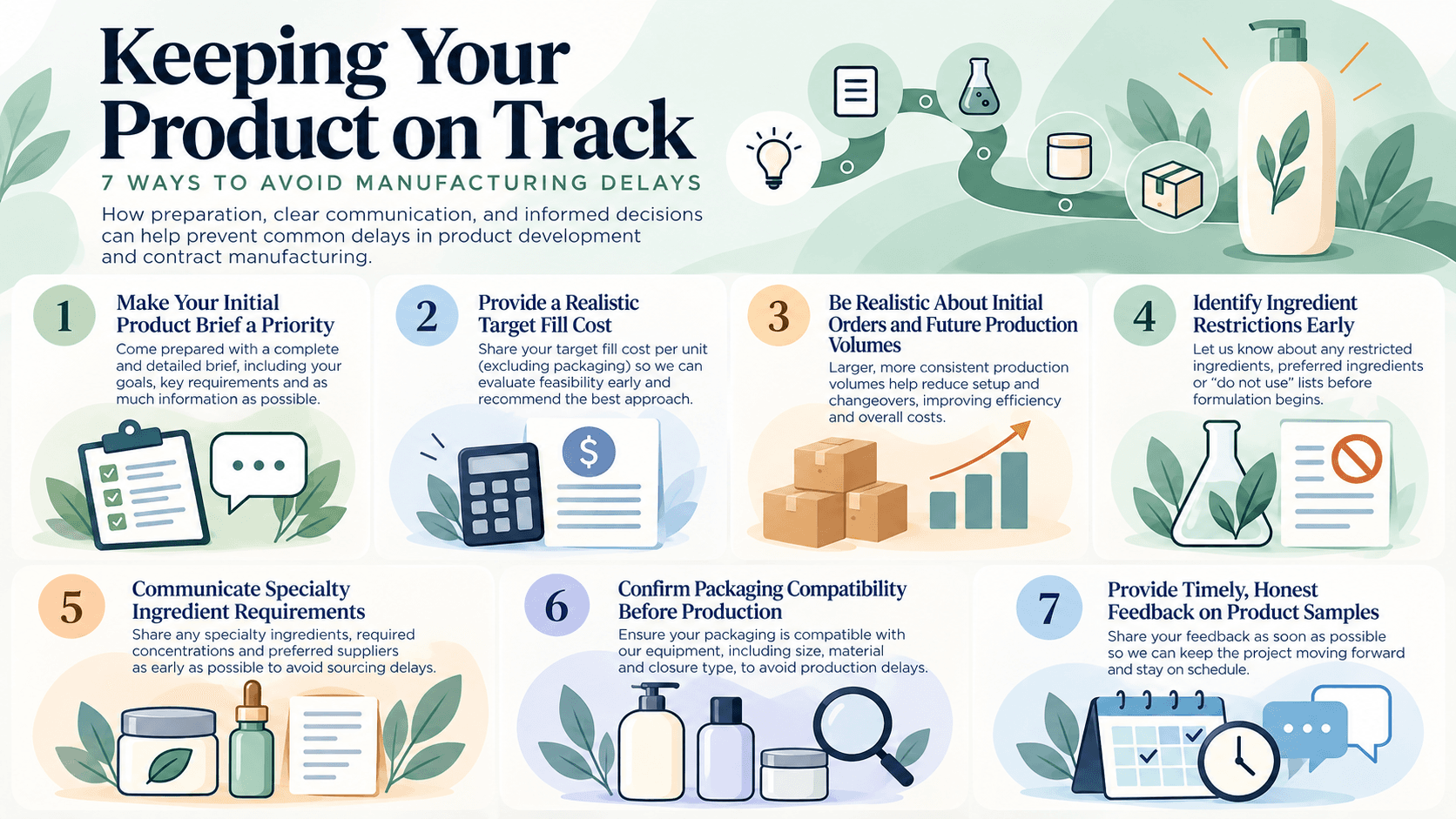
How preparation, clear communication, and informed decisions can help prevent common delays in product development and contract manufacturing.
Bringing a new product to market takes more than a great formula. Pricing, ingredient requirements, packaging, production volumes, and timely feedback all influence how efficiently a project moves forward.
At Ally Labs, we’ve found that some of the most avoidable delays begin with information that wasn’t communicated early enough or decisions that weren’t finalized before development started.
One of the best things you can do to keep your project on track is to come prepared for your initial product brief.
You don’t need a finished formula or every answer, but understanding your product goals, budget, and requirements helps our teams evaluate feasibility and establish an appropriate development direction.
Here are seven common challenges that can slow down product development and manufacturing, why they matter, and what you can do to help avoid them.
The examples throughout this article are hypothetical and illustrate common manufacturing considerations.
1. Make Your Initial Product Brief a Priority
Your first product brief establishes the foundation for your development project.
It’s where we learn what you’re creating, how you want it to perform, and what matters most to your brand.
This meeting is much more productive when you’ve already discussed key product requirements with the appropriate people within your organization.
Before your product brief, be prepared to discuss:
- Product concept: What you’re developing, your target audience, and the characteristics or performance you expect.
- Target fill cost: Your estimated manufacturing cost per unit or an acceptable price range.
- Production volumes: Your expected initial order quantity and realistic future demand.
- Ingredient requirements: Any prohibited ingredients, restricted ingredient families, required specialty ingredients, or specific concentrations.
- Packaging preferences: Your intended container, closure, fill size, and any existing packaging concepts.
- Brand standards: Any certifications, marketing claims, retailer requirements, or consumer preferences that could influence development.
- Decision-makers: Who within your organization is responsible for approving ingredients, pricing, packaging, and the finished product?
Consider this example:
A brand attends its first product brief with a clear vision for a premium body wash. However, its purchasing team hasn’t established a target manufacturing cost, and its marketing team hasn’t communicated the brand’s ingredient restrictions.
Before development can proceed, additional discussions are needed to establish those requirements, delaying a project that otherwise appeared ready to begin.
How to avoid the delay:
Gather input from the people responsible for your brand’s key decisions before attending the meeting.
Whether you’re a brand owner, product manager, purchasing professional, or marketing representative, you don’t need to understand every technical aspect of formulation. That’s where our expertise comes in.
What matters is communicating your expectations, identifying nonnegotiable requirements, and being open about decisions that haven’t been finalized.
The following sections explain why these details matter and how they can affect your project’s cost, formulation, and timeline.
2. Provide a Realistic Target Fill Cost Per Unit
One of the most important questions we ask during product development is:
What is your target cost per unit?
We understand that sharing a target price can feel uncomfortable. Some brands worry that providing a maximum acceptable fill cost means their manufacturer will automatically develop a product priced as close to that number as possible.
At Ally Labs, that isn’t our approach.
We ask for a target price because it helps our R&D team select appropriate formulation approaches and ingredients while evaluating whether your product can realistically be manufactured within your budget.
Raw material costs can vary dramatically. Ingredient selection, concentrations, availability, and performance requirements can all influence the final cost.
Our objective is to develop an effective product that meets your requirements while supporting healthy margins for your brand. Whenever feasible, we work to develop below your target cost rather than simply using the entire available budget.
Why does that matter to us?
Because a successful manufacturing partnership doesn’t end with the first production run.
When a product performs well and its costs support sustainable margins, a brand is better positioned to grow sales, continue offering the product, and place future orders. That’s a better long-term outcome for everyone involved.
Consider this example:
A brand requests a premium lotion featuring several specialty ingredients but provides no target manufacturing cost.
After development begins, the brand reveals that its required unit cost is substantially lower than what the proposed formula and anticipated production volume can support.
The team must now evaluate alternative ingredients, reconsider the product concept, or determine whether the project is commercially feasible.
Development time could have been saved by identifying those financial expectations earlier.
How to avoid the delay:
Provide a realistic target cost or acceptable range during your initial product brief. Clarify what that number includes, whether you’re targeting filling costs or a more complete finished-product cost.
An estimate is much more helpful than no number at all.
For qualified projects, Ally Labs typically provides formulation development and sampling without separate development fees. Unusual or especially costly ingredients and certain project-specific requirements may involve additional expenses, which are evaluated and discussed in advance.
Your target price isn’t an invitation to spend your entire budget. It’s information that helps us develop with your budget in mind.
3. Be Realistic About Initial Orders and Future Production Volumes
Production volume plays an important role in determining manufacturing costs.
Raw material purchasing quantities, packaging, production scheduling, equipment preparation, and labor can all influence the final cost per unit.
One consideration that may surprise brands is how much work happens before a production run even begins.
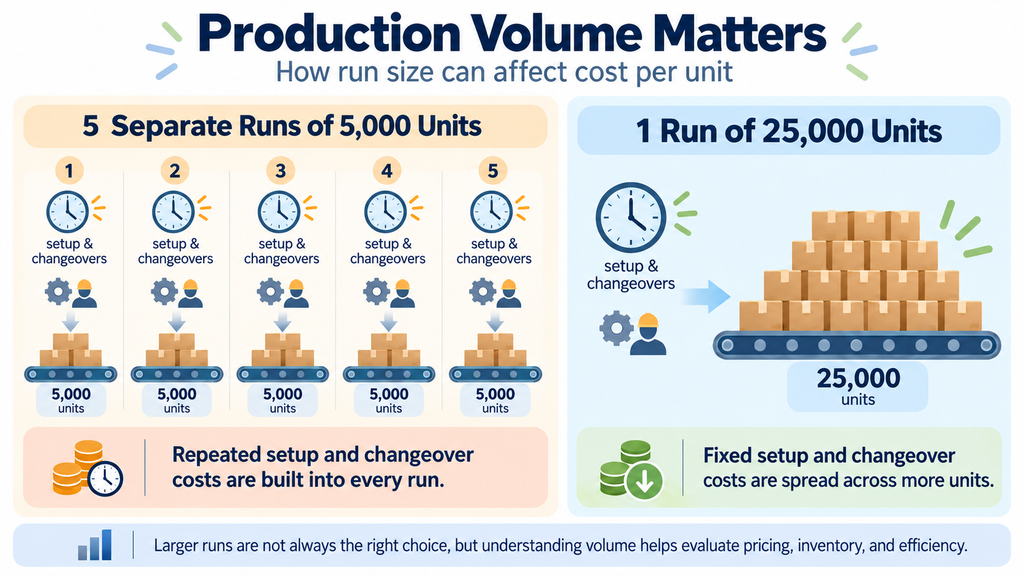
Equipment setup, cleaning, changeovers, and other preparation activities can require significant labor and time regardless of whether a run contains 5,000 units or 25,000 units.
Those costs are accounted for in each production run. Producing more units in a single run allows fixed setup and changeover costs to be distributed across a larger quantity.
Consider this example:
A brand expects to need 25,000 units over several months but requests five separate production runs of 5,000 units each.
Every run requires its own preparation, scheduling, changeover, and associated labor.
Producing the same 25,000 units in one run could eliminate repeated setup costs and reduce their impact on the cost of each finished unit. Larger raw material or packaging purchases may offer additional savings.
However, larger runs aren’t automatically the right business decision. Inventory, storage, cash flow, and realistic demand must also be considered.
How to avoid the delay:
Share both your expected initial order and your realistic projections for future production.
If you’re launching a new brand, we understand that demand may be uncertain. If you have established sales and predictable volumes, that information is equally valuable.
Understanding your expectations allows our team to evaluate production scenarios and identify opportunities to improve unit pricing.
The goal isn’t to encourage you to order more than you need. It’s to help you understand how production volume affects costs and make informed decisions for your business.
4. Identify Ingredient Restrictions Before Formulation Begins
Ingredient restrictions can significantly influence how a product is developed.
Whether they come from brand positioning, consumer preferences, retailer requirements, certifications, or other considerations, they need to be communicated before formulation begins.
It’s particularly important to distinguish between individual ingredients you want to avoid and entire ingredient families your brand doesn’t want to use.
Something that seems obvious within your organization may not be obvious to your manufacturing partner unless it’s clearly communicated.
Consider this example:
A brand requests a rich, creamy moisturizer.
After evaluating the initial sample, the brand explains that its marketing standards prohibit the use of any ingredients containing the word “alcohol” in their names.
The original formula contains a fatty alcohol commonly used in cosmetic products to support texture and consistency.
Although the ingredient serves an appropriate technical purpose, it doesn’t align with the brand’s positioning or its target consumers’ preferences.
The issue isn’t whether the ingredient is suitable for the formulation. It’s that an important brand restriction wasn’t communicated during the initial product brief.
The development team must now evaluate alternatives, adjust the formulation, and begin additional stability testing.
Similar challenges can arise with restrictions involving silicones, certain oils, preservatives, fragrances, or other ingredient categories.
How to avoid the delay:
Provide a written list of prohibited ingredients, restricted ingredient families, and brand-specific standards during your initial product brief.
Be clear about whether a restriction is absolute or simply a preference. If a requirement is driven by marketing standards or consumer perception, communicate that reasoning too.
Make sure the people responsible for your brand’s ingredient requirements have reviewed them before development begins.
Changing an ingredient isn’t always as simple as removing it from a formula. Substitutions can affect texture, performance, stability, and manufacturing considerations.
Even relatively small formulation changes often require a new stability testing cycle. Revised development samples may be provided while testing is underway, but the applicable stability evaluation must be completed successfully before production.
Communicating restrictions early helps prevent unnecessary reformulation, additional testing, and avoidable delays.
5. Communicate Specialty Ingredient Requirements and Concentrations Early
There’s an important difference between wanting a product to deliver a particular benefit and requiring a specific ingredient at a predetermined concentration.
Both are valid product development goals, but they can lead to very different formulation approaches.
Specialty ingredients may involve unique sourcing requirements, higher costs, limited availability, or technical challenges.
Required concentrations can also influence a product’s texture, stability, compatibility, and overall feasibility.
Consider this example:
A brand requests a facial serum designed around a particular consumer benefit.
After the initial formula has been developed, the brand explains that its marketing strategy requires a specific specialty extract at a predetermined concentration.
That requirement changes the development considerations.
The ingredient may require additional sourcing, significantly affect raw material costs, or create formulation challenges that weren’t part of the original approach.
Additional development and stability testing may be necessary before the product can proceed to production.
How to avoid the delay:
Identify required specialty ingredients and concentrations during your initial product brief.
Whenever possible, provide exact ingredient names, relevant specifications, and preferred supplier information.
Distinguish between ingredients that are absolutely required and those you’re willing to consider alternatives for.
If your primary goal is a particular product characteristic, our R&D team can evaluate potential formulation approaches within your target cost.
If a specific ingredient or concentration is essential, we need to evaluate its sourcing, cost, and technical feasibility from the beginning.
The earlier we understand your must-have ingredients, the better we can align development with your product goals, budget, and timeline.
6. Confirm Packaging Compatibility Before Committing to Production
Packaging is an essential part of your product’s identity, but it must also function efficiently in a manufacturing environment.
A container may look perfect from a branding perspective without being well suited to the equipment used to fill, cap, label, or otherwise process it.
Bottle dimensions, neck finishes, closure types, container geometry, and product viscosity can all influence packaging compatibility.
At Ally Labs, clients generally source their own primary packaging, and our team works with them to evaluate its suitability for production.
Physical packaging samples are required for operational testing, even when a package appears compatible with our equipment.
Why?
Because compatibility isn’t simply about whether a container can run on a production line. It’s also about how efficiently it can run.
Two containers may both be compatible with the same equipment but perform differently during filling, handling, or closure application.
Those differences can affect production speed, labor requirements, equipment adjustments, and ultimately the manufacturing cost per unit.
Our operations team determines how many packaging samples are needed based on the components and evaluations required for each project.
Consider this example:
A brand purchases a large quantity of distinctive bottles and closures before having them evaluated by its manufacturing partner.
When physical samples are tested, the containers are technically compatible but require additional handling that slows production.
The packaging can be manufactured, but the slower production rate changes the labor and time needed to complete the run, affecting the anticipated unit cost.
In more challenging situations, new change parts, equipment adjustments, or alternative packaging may be necessary before production can proceed.
How to avoid the delay:
Involve your manufacturing partner in packaging discussions before committing to large purchases.
Provide physical packaging samples as early as possible and remain open to recommendations from marketing and operations about more efficient options.
Sometimes a small adjustment to a container or closure can make a meaningful difference in production speed and costs.
Beautiful packaging matters. Packaging that can be manufactured reliably and efficiently matters just as much.
7. Provide Timely, Honest Feedback on Product Samples
Once a product sample reaches your hands, your feedback becomes one of the most important factors in maintaining project momentum.
Sampling is a collaborative process. An initial sample gives you the opportunity to evaluate the product and determine whether refinements are needed.
You might want a different fragrance, thicker consistency, lighter texture, or adjustments to the product’s appearance or performance.
That’s valuable feedback.
What makes development difficult isn’t constructive criticism. It’s having no feedback at all.
When a sample is delivered but the development team doesn’t receive a response for several weeks, the next steps remain unresolved.
Consider this example:
A brand receives a shampoo sample and begins evaluating it internally.
Three weeks pass without feedback.
When the brand eventually responds, it requests changes to the fragrance, viscosity, and sensory experience.
Those requests may be entirely reasonable, but the formulation team couldn’t begin evaluating them while waiting for direction.
The project has now lost several weeks of potential progress.
How to avoid the delay:
At Ally Labs, we encourage clients to schedule or accept a sample feedback meeting within 7–10 days of the estimated sample delivery date.
If your evaluation requires more time, that’s understandable. Simply communicating your anticipated feedback timeline helps everyone stay aligned.
When providing feedback, be as specific and candid as possible.
If the fragrance isn’t right, tell us. If the product feels too thick or too thin, explain what you’d prefer. If the texture, appearance, or performance doesn’t meet your expectations, we want to understand why.
And if you’ve decided to pause or discontinue the project, that information is valuable too.
Requested changes may require additional formulation work and stability testing, but timely feedback allows us to identify those next steps as early as possible.
We don’t expect every first sample to be perfect. We do need to understand what you think of it.
Successful Product Development Is a Partnership
Every product development project is different. Some involve complex formulations and specialty ingredients, while others require unique packaging or carefully managed production volumes.
Not every challenge can be predicted, and not every delay can be prevented.
But many avoidable setbacks can be reduced through thoughtful preparation, realistic expectations, and consistent communication.
You don’t need to have every answer before contacting a manufacturing partner. What matters is understanding your goals, identifying your nonnegotiable requirements, and staying engaged throughout the development process.
At Ally Labs, we believe successful product development depends on more than formulation expertise and manufacturing capabilities. It requires collaboration, transparency, and a shared commitment to your product’s success.
Have a product concept you’re ready to bring to life?
Connect with our team to discuss your project goals, requirements, and next steps.
The partnership you can lean on.
Keep Reading
What Is an R&D Innovation Spotlight?
A Smarter Starting Point for Product Development Most custom product development begins with a client brief. An R&D Innovation Spotlight begins before there is one. At Ally Labs, our R&D Innovation Spotlights are product concepts our Marketing and R&D teams proactively identify, research, and develop before a client ever reaches out. Instead of starting with […]
GrowthWhen Self-Manufacturing Starts Holding Your Brand Back
Self-manufacturing gives founders control early on. As orders grow it can turn into a bottleneck, and the real cost is rarely the ingredients.
Let's Build the Right Next Product
If you are considering adding a new SKU to your personal care or home care line, Ally Labs can help you explore the product story first. Then, our team can develop the formula, format, and production pathway around the brand, the customer, and the revenue opportunity it is meant to create.